
Published
On September 3rd, 2025, the Office of the Director issued a circular that turned into something much bigger than a simple assignment. The Coding Club and Literary Club was given a challenge: design and build an integrated digital platform for the Geethanjali College of Engineering and Technology community.
At first, it sounded like a straightforward task — build a blog. But as we explored what the college actually needed, we realized this had to be more than just another website. It had to be a scalable platform, one that could grow with student contributions, editorial content, and future features.
What started as a concept on Engineers’ Day slowly evolved into a fully functional platform — the official GCET blog.
The journey from that announcement to the live website was filled with late-night debugging, architecture redesigns, Git conflicts, and countless cups of coffee.
One of the most time-consuming parts of the project happened before we wrote a single line of production code.
We spent several days just figuring out what technologies we should use.
The first big question was simple:
Should we use WordPress or build something from scratch?
WordPress was tempting because it is quick to deploy and widely used for blogs. But it came with several trade-offs:
Since this was being built by a student developer team, we wanted something that would also serve as a learning platform and a long-term system.
So we decided to go with a custom-built architecture using a headless CMS instead of a traditional WordPress setup.
The next debate was the database architecture.
We evaluated two major options:
PostgreSQL
MongoDB
Since blog content often contains nested and evolving structures (authors, tags, images, metadata, revisions, etc.), MongoDB’s document-based model made more sense for our use case.
Eventually, we chose MongoDB because it allowed us to design content models faster and adapt the schema as the platform evolved.
Another important architectural decision was selecting the Headless CMS.
We compared several options and evaluated them based on:
After testing a few options, we decided to go with Payload CMS.
Payload stood out because:
For our use case — a developer-controlled platform with editorial users — Payload turned out to be the perfect fit.
After days of research, discussions, and experimentation, we finalized the architecture.
Our stack consists of:
Next.js 15
Used for building the frontend application. Its App Router, server components, and static rendering capabilities allowed us to build a fast and scalable interface.
Payload CMS
Handles the content management side, allowing editors to publish and manage articles easily while keeping the backend highly customizable.
MongoDB
A flexible document database that stores posts, authors, metadata, and platform data efficiently.
Tailwind CSS + Shadcn/UI
Used to design a clean, responsive interface that works across mobile and desktop devices.
Together, this stack gave us the speed of static sites, the flexibility of a headless CMS, and the scalability of a modern full-stack architecture.
Like every real-world project, this one came with several technical challenges.
The platform needed a clear separation of responsibilities:
Designing this system meant implementing precise role-based access control inside Payload CMS.
We spent multiple days configuring collections, permissions, and hooks to ensure that:
It took several iterations before the workflow felt secure and intuitive.
We wanted the blog to be extremely fast.
The ideal solution was static generation for articles.
However, writers also needed Live Preview, so they could see how their article would look before publishing.
Balancing these two requirements turned into a technical puzzle.
Eventually we implemented a system where:
This gave us the best of both worlds — speed and real-time preview.
Our team consisted of students from:
Across multiple specializations:
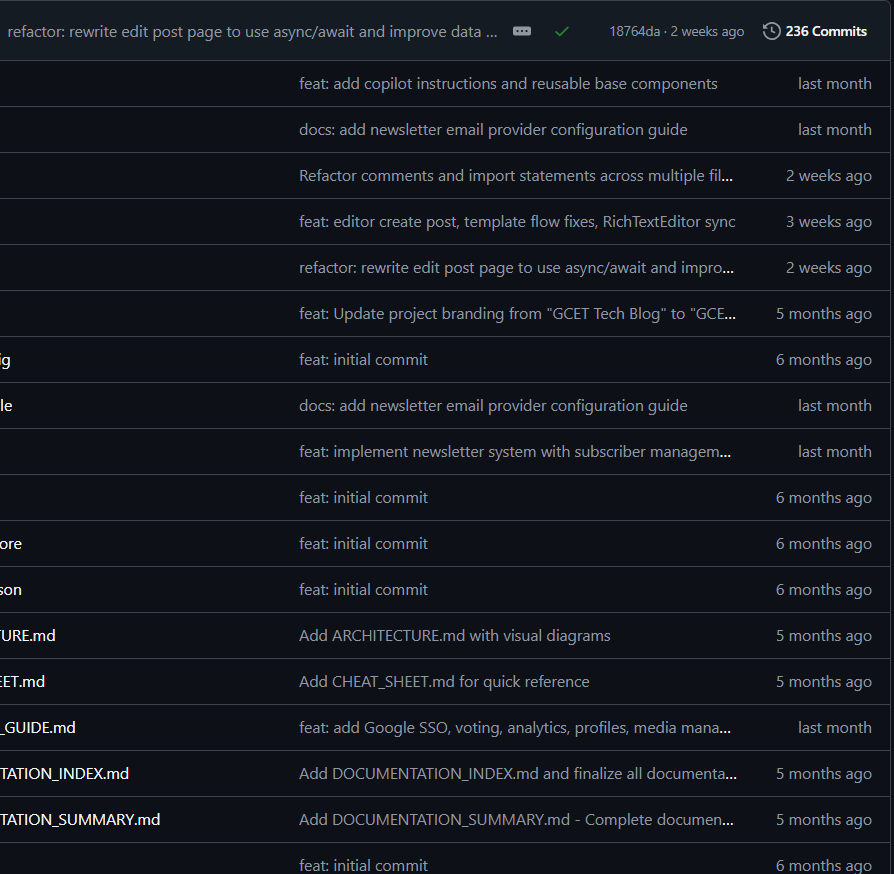
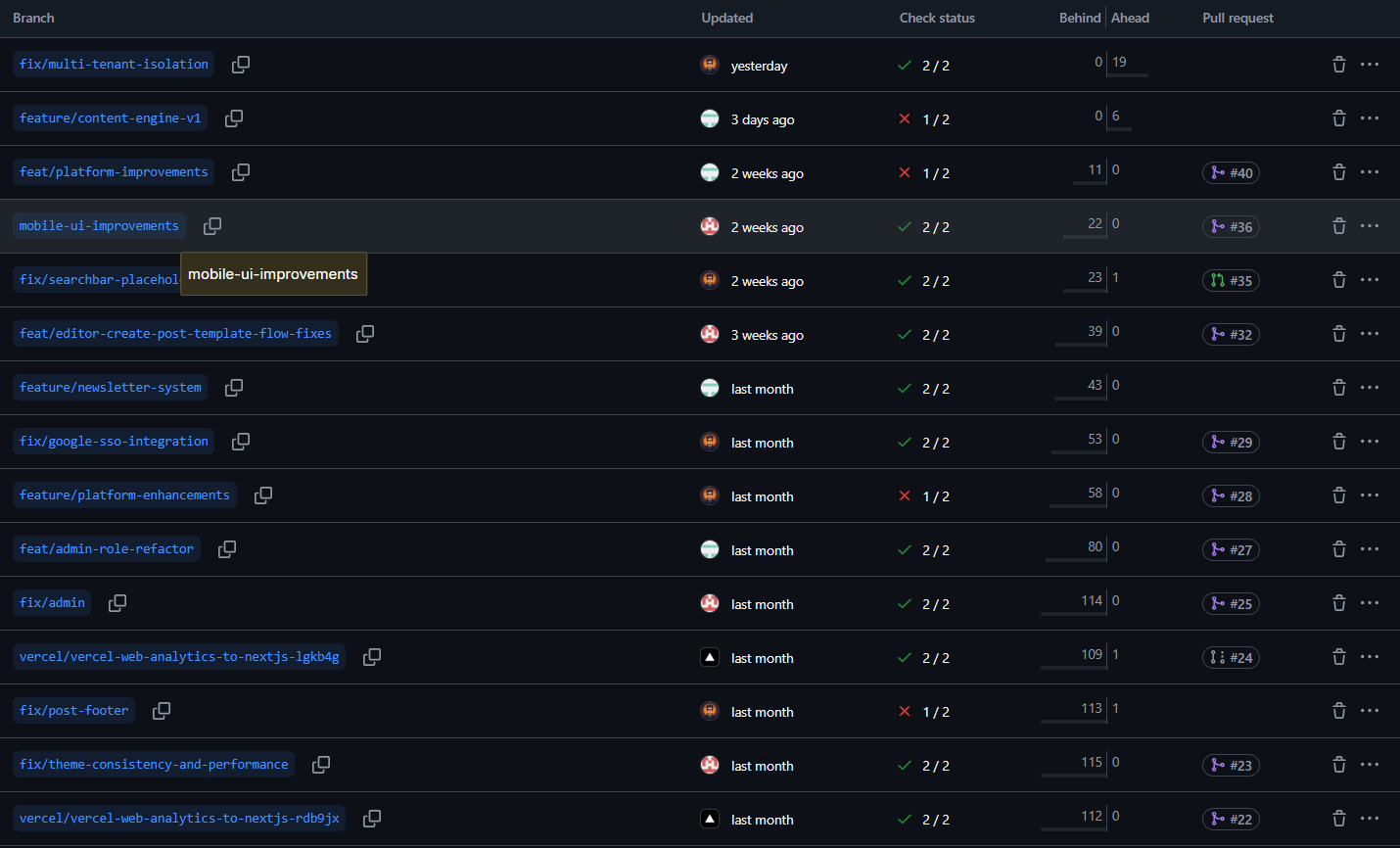
Coordinating schedules, managing Git branches, reviewing pull requests, and resolving merge conflicts became a learning experience in itself.
In many ways, this project taught us real-world software collaboration, something far beyond classroom assignments.
This project was a collaborative effort by students from the CSE department:
Manoj Kumar Sivapuram
III-II, CSE-DS-D
Rishith Kumar Guntuka
II-II, CSE-B
P. Maria Bala Akshay Raj
III-II, CSE-DS-D
Chetana Chowdary
III-II, CSE-AIML
Each member contributed to different parts of the project — from architecture discussions and backend setup to frontend development and system integration.
This blog platform is only the first step.
We designed the system with scalability in mind, which means many features can be added in the future.
Some ideas we are already exploring include:
Because the platform is built on a modern full-stack architecture, adding new features will be much easier moving forward.
This blog isn’t just a website.
It’s a platform for students, faculty, alumni, and contributors to share knowledge, experiences, and ideas.
To every student who reads this:
This platform belongs to you.
Write about your projects, share your learning journey, document your experiments, and contribute to the growing digital voice of our college.
We’re excited to see the stories that will be written here.
Happy Coding.
Explore how AI impacts jobs—automation vs. opportunity. Learn why human oversight, prompt engineering, and creative roles make AI a partner, not a threat.

I took a closer look at the Lindsay Clancy case to separate what we actually know from the claims spreading online from the 51-call controversy and Wi-Fi questi

As an AI & ML student, I share my learning journey, insights, and experiences in understanding artificial intelligence and machine learning .

Not Just Smart, But Responsible: Why AI Needs to Be Ethical and Explainable
Get new articles from GCET directly in your inbox. No spam, just knowledge.
Explore how AI impacts jobs—automation vs. opportunity. Learn why human oversight, prompt engineering, and creative roles make AI a partner, not a threat.
I took a closer look at the Lindsay Clancy case to separate what we actually know from the claims spreading online from the 51-call controversy and Wi-Fi questi
As an AI & ML student, I share my learning journey, insights, and experiences in understanding artificial intelligence and machine learning .
Your comment will be reviewed before being published.
You must be logged in to comment
Log InNo comments yet - be the first to share your thoughts!
